Supernatural Belief and Witchcraft
Panic RoomSupernatural Belief and Witchcraft are presented not as a settled system of magic but as a persistent uncertainty that changes how characters explain grief, misfortune, and obligation. The novel places inherited claims about the Fry family’s powers beside explicit doubts about trickery and self-suggestion. Its uncanny episodes remain consequential without becoming conclusive: people may question what happened, but their actions are still altered by what they believe.
Inherited Beliefs and Family History
The Fry family’s reputation for witchcraft reaches Don Challenor through Maris Hemsley’s account of her research into the occult. Maris describes Calensa Fry as initially denying that she possessed supernatural powers. Calensa said she relied on psychological manipulation to sustain her reputation and business, and that events attributed to her were self-induced by the people experiencing them. Maris suspected this explanation might itself be a double bluff: Calensa could be daring her to dismiss the supernatural even while knowing that her own experiences made dismissal difficult. The account leaves both readings in play rather than confirming either one.
Calensa’s beliefs also bind witchcraft to a long memory of family conflict. She wanted Maris to accuse Jack Harkness in print of responsibility for the death of her grandson, Jory Fry. Maris could not fit that accusation into an academic study, and she had no evidence that would establish it. Calensa nevertheless insisted that Harkness had drowned Jory at a rock pool on 1 August 1970, a date she repeatedly invoked. She treated the date’s coincidence with Lammas as significant, though Maris did not understand why. Calensa also connected the Harkness–Fry feud to the Cornish rising of 1648, saying the families had stood on opposing sides. At Tredarvas Farm, where Maris met her in the kitchen, those old claims became part of a continuing account of grievance rather than a distant, settled past.
Divination and the Need for Certainty
A separate episode links divination to the distress of Jane Glasson’s disappearance. After Jane finished her second year at Cambridge, she travelled to London with a friend, parted from her at King’s Cross station, and said she would take the Tube to Paddington for a train to Cornwall. Andrew Glasson went to Camborne to meet her, but she was not on the train. Her family initially expected a misunderstanding or a later arrival; the uncertainty continued, and Andrew recalled that not knowing had devastated Jane’s mother.
Blake, who had spoken with Andrew about Jane, suggested that he consult a seer to learn whether Jane was alive. He hesitated before agreeing, and expected that he would recognize a charlatan. Instead, the seer asked him to shuffle ordinary playing cards, cut the pack, and deal twelve cards face down. She turned them over in a sequence he could not fully recall. All but one were red hearts or diamonds. The seer interpreted red as life and told him that Jane was alive. Andrew allowed himself to believe her, while acknowledging how powerfully a person in his circumstances might cling to a hopeful sign. The scene does not verify the reading; it shows how an uncertain pattern can acquire authority when it appears to answer an unbearable question.
Don Challenor’s Encounter with Wynsum Fry
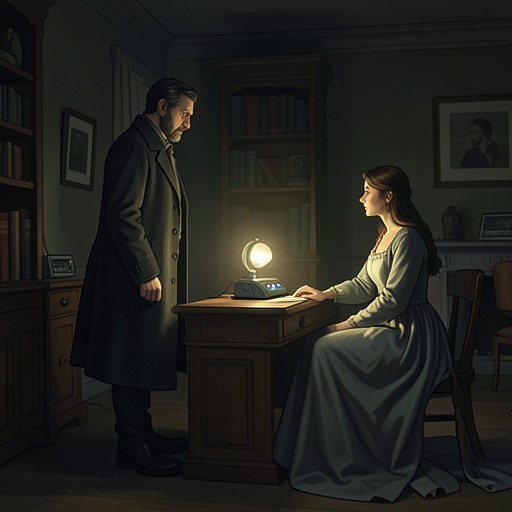
Don’s meeting with Wynsum Fry makes the tension between skepticism and experience personal. He approaches her bungalow in Helston apprehensively, aware that his public bluster about the occult does not match a deeper suspicion that witchcraft may be more than charlatanry. Wynsum is willing to discuss Jack Harkness, but makes clear that another card reading would require payment. She also warns Don that some futures are better left untold, placing foreknowledge itself under suspicion rather than offering it as a simple benefit.
The encounter turns on a promise and a handshake. Wynsum extends her hand; Don expects the contact to cause the wrist pain he associates with her, but the touch is light and painless. She tells him that a lightly given promise is heavy to break. He then feels suddenly ill, goes into the bathroom, and vomits. While recovering, he looks in the circular mirror and sees his reflection blurred even though the rest of the room remains in focus. When he looks again, the reflection is sharp. The episode offers no independent explanation for either the visual disturbance or its brief duration.
Afterward, Don realizes that his wrist no longer hurts. The relief echoes his earlier account of experiences connected to the Fry family. He says his susceptibility seemed absurd when he was away from Exeter, but returned when he went back; after confessing to Calensa that he had tried to deceive her, he ceased to be accident-prone. He does not believe that change was coincidence, while also describing himself as rational. The narrative preserves that contradiction: his interpretation is not proof of supernatural power, but neither can he make the experience feel irrelevant simply by calling it irrational.
Belief as Influence and Narrative Method
Witchcraft also functions as a means of influencing other people, whether or not its claims are true. When Don encounters Zlenko, he sees fear in the man’s eyes and decides to use it. Don tells him that another witch had explained how to neutralize Wynsum’s power, beginning with the need for an item of clothing worn next to her skin. The available scene establishes Don’s tactic, not whether the proposed countermeasure works. Belief here has an immediate social effect: Don recognizes a fear and uses a supernatural explanation to direct the moment.
Across these episodes, supernatural belief is neither reduced to a confirmed force nor dismissed as an empty fraud. Cards give Andrew a reason to hope; Calensa’s claims preserve a family accusation across generations; Wynsum’s words attach weight to Don’s promise; and Don turns occult language into a tool when he sees Zlenko’s fear. Each case differs in motive and consequence, but all make interpretation consequential. The unresolved question is not only whether witchcraft exists, but how people act when they cannot confidently separate supernatural power from manipulation, coincidence, or the pressure of their own expectations.